For Kids


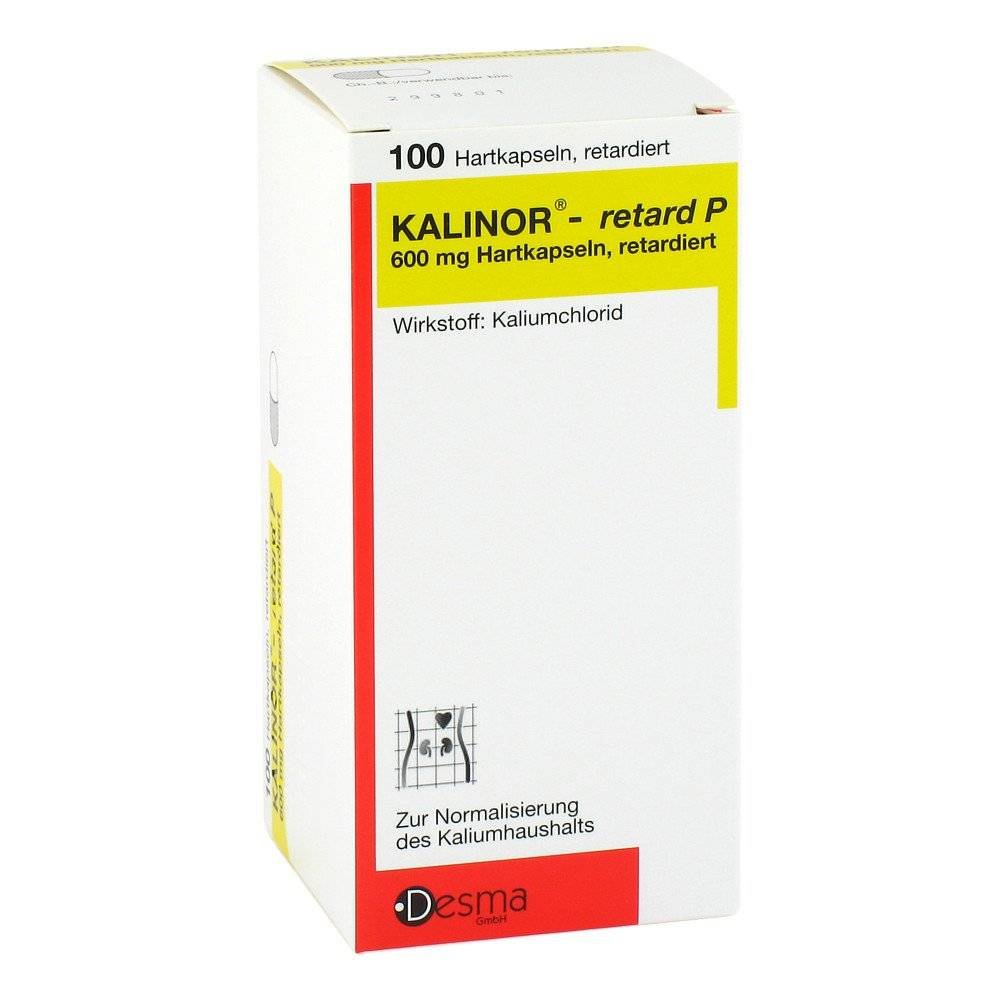



Kalinor retard P 600 mg hard capsules, 100
€30.81
Treatment for potassium deficiency
Prevention of excessive potassium excretion
The following information applies unless your doctor has prescribed the medicine differently. Please follow the instructions for use, otherwise the drug cannot work properly!
How much and how often should you take the preparation?
The dosage is based on the loss of potassium to be compensated and is adjusted by the doctor for you personally.
Unless otherwise prescribed, the following guide values apply:
To prevent a potassium deficiency, generally 2 – 3 capsules daily (corresponding to 16 – 24 mmol K +). It can be started with a dosage of 3 x 1 capsule daily. Thereafter, the dosage may have to be adjusted to your personal potassium requirements.
For the treatment of potassium deficiency 5 – 12 capsules daily (corresponding to 40 – 96 mmol K +). It can be started with a dosage of 3 x 2 capsules daily. Thereafter, the dosage may have to be adjusted to your personal potassium requirements.
When should you take the preparation?
As long as the cause of the potassium deficiency persists, continuous administration of the drug is recommended. In other cases, days or weeks are often enough to compensate for the potassium deficiency.
What should be done if the preparation has been taken in too large quantities (intentional or accidental overdose)?
Normally functioning kidneys quickly excrete excess potassium. A threatening increase in the blood potassium concentration is only to be expected in the event of a considerable overdose. Since the normal function of the heart is impaired in the event of extremely high blood potassium concentrations, a doctor should be consulted immediately in the event of a significant overdose. The doctor can use a laboratory test to determine the blood potassium concentration and / or check the heart rhythm using an EKG. If necessary, the doctor can take appropriate measures to normalize the heart function and the blood potassium concentration. If the blood potassium concentration is only slightly elevated, normal excretion of potassium via the kidneys can result in normalization even without further treatment.
What should you watch out for if you have not taken enough of the product or if you take a
Forgot to take?
If you have forgotten to take a dose, you can do so at a later time. You should not take more than 2 capsules at once.
What should you watch out for if you interrupt or end treatment prematurely?
If you are to take the medicine to correct a potassium deficiency or to prevent a potassium deficiency from developing, then this supply of potassium is necessary to keep your potassium levels in balance. Without this additional potassium intake, your dietary potassium intake will not be sufficient to meet your current potassium needs. Therefore, if you interrupt or stop taking it prematurely, you may develop a potassium deficiency, which has adverse effects on the heart and on the functioning of nerves and muscles.
Die folgenden Angaben gelten, soweit Ihnen Ihr Arzt das Arzneimittel nicht anders verordnet hat. Bitte halten Sie sich an die Anwendungsvorschriften, da das Arzneimittel sonst nicht richtig wirken kann!
Wie viel und wie oft sollten Sie von dem Präparat einnehmen?
Die Dosierung richtet sich nach dem auszugleichenden Kaliumverlust und wird vom Arzt für Sie persönlich angepasst.
Soweit nicht anders verordnet, gelten die folgenden Richtwerte:
Zur Verhütung eines Kaliummangels im allgemeinen täglich 2 – 3 Kapseln (entsprechend 16 – 24 mmol K+). Es kann mit einer Dosierung von 3 x 1 Kapsel täglich begonnen werden. Danach ist die Dosierung gegebenenfalls Ihrem persönlichen Kaliumbedarf anzupassen.
Zur Behandlung eines Kaliummangels täglich 5 – 12 Kapseln (entsprechend 40 – 96 mmol K+). Es kann mit einer Dosierung von 3 x 2 Kapseln täglich begonnen werden. Danach ist die Dosierung gegebenenfalls Ihrem persönlichen Kaliumbedarf anzupassen.
Wann sollten Sie das Präparat einnehmen?
Solange die Ursache des Kaliummangels weiterbesteht, ist eine fortlaufende Gabe des Arzneimittels empfehlenswert. In anderen Fällen reichen oft Tage bis Wochen für den Ausgleich des Kaliummangels aus.
Was ist zu tun, wenn das Präparat in zu großen Mengen eingenommen wurde (beabsichtigte oder versehentliche Überdosierung)?
Durch normal arbeitende Nieren wird überschüssig zugeführtes Kalium rasch wieder ausgeschieden. Eine bedrohliche Überhöhung der Blut-Kaliumkonzentration ist so nur bei erheblicher Überdosierung zu erwarten. Da bei stark überhöhten Blut-Kaliumkonzentrationen die normale Funktion des Herzens beeinträchtigt wird, sollte bei erheblicher Überdosierung unbedingt unverzüglich ein Arzt aufgesucht werden. Durch eine Laboruntersuchung kann vom Arzt die Blut-Kaliumkonzentration bestimmt und/oder mittels EKG der Herzrhythmus überprüft werden. Falls notwendig, kann der Arzt dann durch geeignete Maßnahmen die Herzfunktion und die Blut-Kaliumkonzentration normalisieren. Bei nur leicht überhöhter BlutKaliumkonzentration kann durch die normale Ausscheidung von Kalium über die Nieren auch ohne weitere Behandlung eine Normalisierung eintreten.
Was müssen Sie beachten, wenn Sie zuwenig von dem Präparat eingenommen oder eine
Einnahme vergessen haben?
Haben Sie die Einnahme einmal vergessen, so können Sie dies zu einem späteren Zeitpunkt nachholen. Dabei sollten Sie aber nicht mehr als 2 Kapseln auf einmal einnehmen.
Was müssen Sie beachten, wenn Sie die Behandlung unterbrechen oder vorzeitig beenden?
Wenn Sie das Arzneimittel einnehmen sollen, um einen Kaliummangel zu beheben oder die Entstehung eines Kaliummangels zu verhindern, dann ist diese Kaliumzufuhr notwendig, um Ihren Kaliumhaushalt im Gleichgewicht zu halten. Ohne diese zusätzliche Kaliumzufuhr ist bei Ihnen die Kaliumzufuhr mit der Ernährung nicht ausreichend, um Ihren aktuellen Kaliumbedarf zu decken. Wenn Sie die Einnahme vunterbrechen oder vorzeitig beenden, kann sich daher bei Ihnen ein Kaliummangel entwickeln, der ungünstige Auswirkungen auf das Herz und auf die Funktion von Nerven und Muskeln hat.